
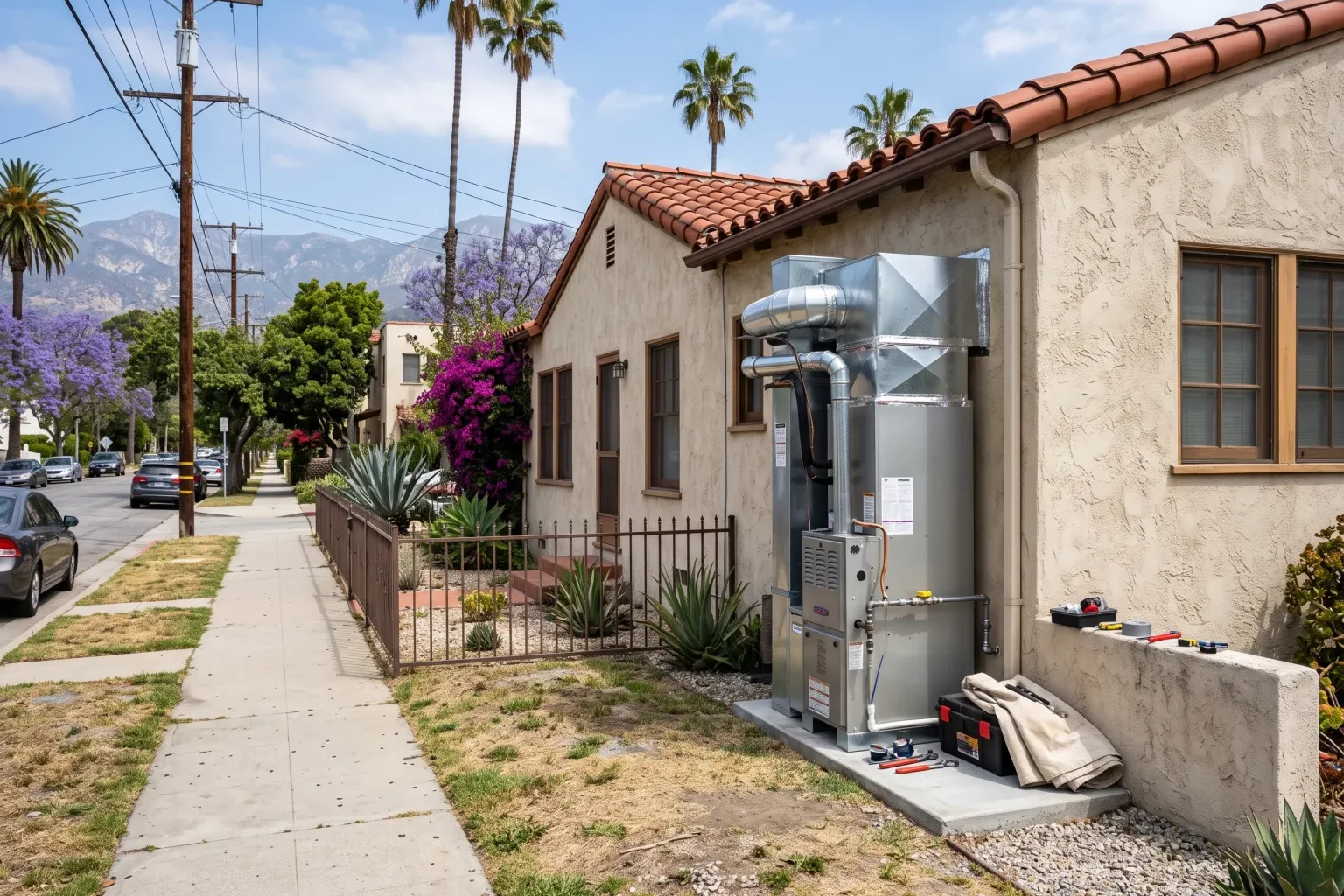
The short answer
Heating repair covers furnaces, heat pumps, wall heaters, floor furnaces and ductless units. We identify the system type, test controls, airflow and the heat source, and recommend repair unless safety or repeated failures make replacement the better path.
Heating in Valley homes comes in more shapes than people expect. One street might have attic gas furnaces, heat pumps on side-yard pads, wall heaters in hallways, a floor furnace in a 1950s ranch and a ductless head in a converted garage. Each fails in its own way, and each needs a technician who recognizes the equipment instead of treating it like a generic box. Climvanta HVAC Repair Service repairs all of these heating types for homeowners in Tarzana and the communities around it. On this page you will find the signals that something is wrong, the troubleshooting process we follow for each kind of system, guidance on when fixing makes sense and when it does not, the elements that set the price of a repair, and a step-by-step look at a service appointment.
Signals that your heat needs attention
Cold weather in Tarzana is short but real. Nights in December and January can drop low enough that a dead heater makes the house uncomfortable within hours, especially in homes with single-pane windows or little wall insulation. Look out for:
- Heat that comes on but never brings the house up to the thermostat setting
- A heat pump that blows lukewarm air for long stretches or ices over and stays frozen
- A wall heater or floor furnace whose pilot will not stay lit
- Burning dust smells that continue well after the first run of the season
- Uneven heat, with some rooms toasty and others cold
- A thermostat screen that goes blank, resets or ignores changes
How we troubleshoot different heating systems
We start every call by confirming what kind of system you have and how it is supposed to work, because the diagnosis path differs a lot from one to the next.
For gas furnaces, we follow the ignition sequence and test the inducer, pressure switch, igniter, flame sensor, gas valve and limit controls, and we check the heat exchanger and venting. For heat pumps, we look at the reversing valve, defrost board and sensors, refrigerant pressures, outdoor coil condition and auxiliary heat strips. Wall heaters and floor furnaces get a close look at the pilot assembly, thermocouple, gas valve and combustion area, since these older appliances often live in tight spaces with limited airflow. Ductless systems are checked for sensor faults, error codes, clogged filters and indoor coil buildup.
Across all types, we test the thermostat and its wiring, confirm the breaker and disconnect are working, and look at the air path. A surprising number of heating complaints come down to airflow: a filter jammed with dust from a smoky fall, a closed return grille behind furniture or a duct that has slipped off its boot in a hot attic.
When to fix and when to move on
Repair is the right call for most heating problems. Parts like igniters, thermocouples, capacitors, sensors and control boards can usually be swapped quickly, and they return a sound system to service.
Replacement deserves a conversation when the issue is safety-related and not practical to repair, such as a cracked furnace heat exchanger or a floor furnace with serious corrosion. It also comes up when an older unit needs several major parts in a row or when replacement parts are no longer made. Floor furnaces and older wall heaters are a common example; many owners use the moment to switch to a heat pump or ductless system that also adds cooling. If you are considering a new gas furnace instead, keep in mind that South Coast AQMD Rule 1111 governs NOx emissions for gas furnaces sold and installed in the region, and the district has been revising it toward zero-emission requirements, so we check the current rule before recommending equipment.
Small checks you can make before calling
Some heating calls end with a reset switch or a dead battery, and you may prefer to rule those out first. None of the steps below involve opening the burner compartment or touching gas parts, which should always be left to a technician.
Start at the thermostat. Confirm it is set to heat rather than cool or off, that the setpoint is above room temperature, and that the display is not blank from weak batteries. Next, look at the breaker panel for a tripped heating or air handler circuit, and check that the service switch near the furnace or air handler, which often looks like an ordinary light switch, has not been turned off by accident.
Then pull the filter. A filter caked with dust after smoky or windy weeks can trip a furnace safety limit or starve a heat pump coil of air. Replacing it and waiting a few minutes sometimes brings the heat back. If the system still will not run, or it starts and quits again, schedule a repair rather than repeatedly resetting it, because a safety control that keeps tripping is telling you something specific.
Elements that set the repair price
After diagnosis, we explain the fault and the cost of fixing it before starting. The amount depends on several things:
- The type of heating system and how specialized its parts are
- Where the equipment sits, with attics, crawlspaces and floor furnace pits requiring extra time
- The specific part that failed and whether it is in stock or must be ordered
- Whether a refrigerant leak search is involved on a heat pump
- Related corrections such as resealing a duct joint, clearing a vent or replacing a thermostat
Your appointment from start to finish
Scheduling begins with a short conversation about what you have noticed, what kind of heater you have if you know, and where it is located. That helps the technician come prepared with likely parts for your equipment.
On site, the technician listens to your description first, then inspects and tests the system. You will hear what we found and what we recommend, with options where there are any, before work begins. After the repair, we run the system through full heating cycles, measure output temperature, verify safety shutoffs and confirm the thermostat is controlling it properly. We also share anything worth watching, so you are not surprised by the next cold snap.
Heating Repair by city
- Heating Repair in Hidden Hills
- Heating Repair in Calabasas
- Heating Repair in San Fernando
- Heating Repair in Beverly Hills
- Heating Repair in West Hollywood
- Heating Repair in Santa Monica
- Heating Repair in Agoura Hills
- Heating Repair in Simi Valley
- Heating Repair in Burbank
- Heating Repair in Los Angeles
- Heating Repair in Culver City
- Heating Repair in Westlake Village