
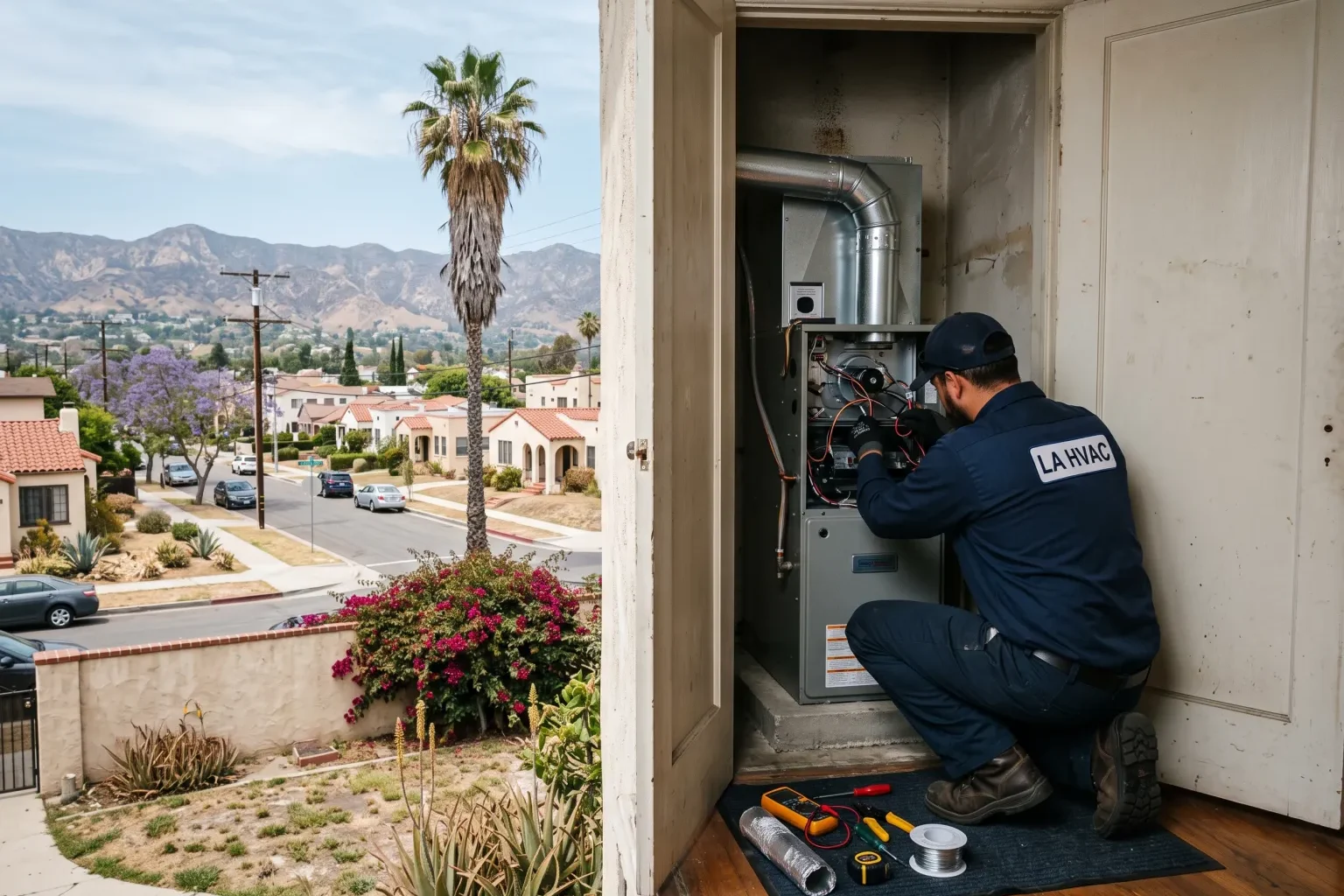
The short answer
Replacing a furnace makes sense when the heat exchanger is compromised, repairs keep repeating, or the unit no longer heats the house evenly. We inspect the existing equipment, ductwork, venting and gas line first, then recommend a correctly sized unit that meets current South Coast AQMD rules.
Most furnaces in the San Fernando Valley live quiet lives. They sit in an attic, a hall closet or a garage corner, run hard for a few weeks around December and January, and get ignored for the rest of the year. That light duty is exactly why replacement often catches people off guard: a unit can look fine on the outside while its heat exchanger, inducer motor or control board has been wearing down for a long time. Climvanta HVAC Repair Service replaces gas furnaces and air handlers for homeowners in Tarzana and nearby cities. Below you will find the warning signs that point toward a new unit, the inspection we carry out before quoting, an honest look at repair versus replacement, the details that drive the price of a project, and the order of events on installation day. There is also a short section on the regional emissions rule that now affects every gas furnace sold here.
Clues that your furnace is near the end
Age alone is not a reason to replace a furnace, but certain symptoms tell us the equipment is running out of useful life. If you notice several of these at once, an inspection is worth scheduling before the first cold snap rather than during it.
- Cracks, heavy rust or soot around the burner area or heat exchanger
- A carbon monoxide alarm that sounds when the heat runs
- Burner flames that flicker, lift or burn yellow instead of a steady blue
- The same part failing again, such as an igniter, flame sensor or inducer motor
- Rooms that never warm up even after hours of running, while the blower sounds normal
- Loud booms at ignition, rattling cabinet panels or a burning odor that lingers well past the first run of the season
Our pre-installation inspection
A furnace swap is not just pulling the old box out and sliding a new one in. In older Tarzana houses, many of which still carry original sheet metal or early flex ducts in a hot attic, the equipment around the furnace often matters as much as the furnace itself. Before quoting, a technician looks at the whole installation.
That inspection covers the gas supply line and shutoff valve, the flue or vent pipe and its clearances, the return air path and filter location, the condition and sealing of supply ducts, the platform or closet the unit sits in, and the thermostat wiring. We also do a load estimate for the house so the new furnace is sized to the rooms it actually serves, not simply copied from the label on the old one. Oversized furnaces short-cycle, run louder and wear out faster; undersized ones struggle on the few genuinely cold nights the Valley gets.
If the furnace shares a cabinet with an air conditioning coil, we check the coil and refrigerant lines too, since a new blower and an old coil have to work well together.
Repair it or replace it?
We start from the assumption that a working furnace should be repaired if the repair is sound. A failed igniter, a dirty flame sensor, a worn blower capacitor or a tripped limit switch can usually be fixed in one visit, and replacing a whole unit for one of those faults would be a waste of your money.
Replacement becomes the stronger choice when the heat exchanger is cracked, when a major component such as the gas valve or control board fails on an older unit that also has other wear, or when you have paid for several repairs in a short span. It also makes sense if you are already planning other work, such as new ductwork or a cooling upgrade, because doing both at once avoids paying for access twice.
Some households use a replacement as a chance to move away from gas entirely. A heat pump can handle both heating and cooling in this climate, and we are glad to price both options side by side so you can compare.
Regional emissions rules for gas furnaces
South Coast AQMD Rule 1111 limits nitrogen oxide emissions from natural-gas fan-type central furnaces sold and installed in the Los Angeles region. The district has been amending the rule toward zero-emission requirements, and it sets and revises the compliance dates itself. Anyone planning a furnace replacement should check the current version of the rule, and we review it with you when we recommend equipment so the unit you choose is one that can be installed in your home.
Factors that change the price of a new furnace
We quote each job after the inspection because the variables below differ from house to house:
- Furnace type and efficiency, including single-stage, two-stage and variable-speed models
- Location: attic installs need safe access, a service platform and sometimes extra labor
- Venting changes, especially when moving from an older atmospheric unit to a high-efficiency model
- Duct repairs, transitions or a new return needed to match the new blower
- Gas line, electrical or condensate drain updates
- Whether a matching cooling coil or thermostat is replaced at the same time
What happens from quote to first heat
Once you choose a unit, we schedule the installation and arrive with the furnace, venting parts and materials prepared. The crew lays down floor protection along the path to the attic or closet, shuts off gas and power, and removes the old furnace for disposal. The new unit is set level, connected to the gas line, vent, ductwork and wiring, and every gas fitting is leak-checked.
Then comes start-up. We measure gas pressure, confirm the flame is stable, check temperature rise across the heat exchanger and verify that safety controls shut the burners off when they should. Finally, we set up the thermostat, show you where the filter goes and how often to change it, and leave the work area clean.